Radical Multiplicity
---
description: on the innumerable realities of a single musical composition
code: darXiv_1
version: v1.1
author: dark
tags: ["music phenomenology", "music cognition", "attention"]
pdf: /darxiv/radical-multiplicity.pdf
github: https://github.com/darXiv/research/tree/main/radical-multiplicity
---
Abstract
No organism ever experiences the same piece of music the same way twice. Musical experience exhibits radical multiplicity: repeated encounters with the same musical composition generate distinct phenomenal realities. Radical multiplicity emerges as a necessity from finite and variable attention recursively sampling high-dimensional attentional space. Each moment of listening occupies a distinct attentional state; each encounter unfolds as a succession of such states, tracing a unique attentional trajectory through attentional space. Compositions function as probabilistic constraint-surfaces: landscapes of likelihood that structure attentional space, guiding attention without determining specific paths. From this architecture, identical trajectories are vanishingly improbable, yielding the phenomenology of inexhaustibility, interpretive diversity, and revisitation. The framework generalizes, providing theoretical foundations for attention-driven signal processing across phenomenological, computational, and neuroscientific paradigms.
On Radical Multiplicity
Why does an organism revisit a composition a thousand times across its lifetime?
Language speaks of listening to a piece of music as if each encounter manifested the same phenomenal reality. This uniformity fails in experience: the same composition unfolds differently across repeated listenings, each encounter disclosing aspects previously unmanifested, never exhausting what remains to be heard.
Consider repeated encounters with a dense harmonic drone. First encounter: a monolithic wall of sound, oppressive, undifferentiated. Second encounter: the wall fractures: upper partials emerge prominently against a foundational hum. Third encounter: attention locks onto beating frequencies, textures become granular, pulsing. Fourth encounter: all of this recedes; what comes forward is the negative space the drone yields, suffusing reality itself: the way it tints ambient light, weighs on the body, and reshapes the felt quality of the surrounding environment into affective textures. Same composition, radically different realities.
Across these encounters, whether it is one organism revisiting a composition or different organisms encountering the same composition, attention traces fundamentally different trajectories through high-dimensional attentional space. Each listening promises and delivers genuine discovery: untraversed territories, hidden textures, unearthed emotions, novel insights. This is radical multiplicity: encounters with a single fixed composition enable innumerable realities. This multiplicity is radical not necessarily in the magnitude of difference between individual trajectories. Some may differ minimally (slight positional shifts), others substantially (traversing entirely different regions). Rather, it is radical in that two encounters with the same composition will effectively never trace the same attentional trajectory.
On Musical Composition
This framework focuses on recorded musical compositions. In listening, the composition advances through its invariant, encoded temporal content. Recordings provide acoustic determinacy: the encoded waveform remains acoustically fixed across encounters, yet each encounter with it enables multiple attentional trajectories.
On Attention
Attention is a resource allocation mechanism. Computational models characterize attention as priority maps or saliency-based selection (Itti & Koch, 2001), and auditory scene analysis demonstrates how finite processing resources partition complex acoustic scenes into attentional streams (Wang & Brown, 2006).
Finite Capacity. Attention is a limited resource distributed across competing phenomena: allocating attention to one phenomenon means less capacity available for others (Kahneman, 1973; James, 1890).
Selectivity. Finite capacity induces selectivity. This selectivity is phenomenologically evident in the partiality of experience: an organism does not grasp the entire cosmos when it looks up into the stars. Certain phenomena come into sharp relief while others recede into diffuse awareness. We are thrown (Heidegger, 1962) into one attentional state rather than occupying all states simultaneously.
Variability. Attention is variable. This variability stems from the organism's state changes, environmental factors, memory activation, and stochastic processes. Micro-deviations in attention cascade through butterfly effects (sensitivity to initial conditions characteristic of chaotic dynamical systems Lorenz, 1963), such that a minor drift opens entirely new regions of attentional space. Even nominally identical organisms yield divergent trajectories, as small perturbations amplify through recursive cascade.
On Attentional Space
The attentional space is the space of all possible configurations of attention. Attentional dimensions are degrees of freedom in attentional configuration. Radical multiplicity observed across repeated encounters provides empirical evidence for high-dimensional attentional space. Phenomenological analysis reveals that distinct musical experiences vary along multiple dimensions independently, each constituting a degree of freedom. One encounter may attend to shimmering upper frequencies with expansive spatial diffusion, while another focuses on dense low-frequency drones with forward-driving momentum. These variations occur along distinct phenomenal axes: spectral, affective, memorial, spatial, temporal, among others, spanning all aspects of experience, not only acoustic features. While certain qualities may correlate in practice (harmonic tension often co-occurs with affective tension), each dimension admits separate variation: variation along one axis does not necessitate variation along others. Whether these dimensions exhibit statistical independence, partial correlation, or more complex interdependencies remains a question for future work in mathematical modeling. If two encounters yield different experiences, they must occupy different positions in attentional space, demanding degrees of freedom sufficient to accommodate variation along all observed phenomenal axes.
Attentional states. At each moment of listening, attentional allocation determines a distinct position in attentional space. Attentional space is a state space: its points represent instantaneous configurations of attention. Analysis requires windowing time into discrete observation moments: a moment is the minimal analytic partition at which attention is sampled. Empirical work on temporal perception supports discrete sampling models of attention (VanRullen & Koch, 2003; Pöppel, 1997). Musical experience unfolds as attention traversing attentional space state-by-state, each successive moment sampling a new state. Each location in attentional space defines a distinct configuration with different coordinates, regional weightings, and co-present phenomenal qualities.
Granularity. Attentional states possess internal dimensionality: each state is simultaneously a location in high-dimensional space and a configuration across multiple coordinates, making each moment a rich, multi-faceted phenomenon. Attentional states may be analytically decomposed into constituent coordinates (frequency intensities, spatial positions, affective tensions, memorial qualities). These coordinates organize into emergent regions: density gradients where certain phenomenal qualities become prominent while others recede. This high-dimensional structure enables granular precision that exceeds conventional music-theoretic categories. Where traditional analysis identifies motifs, harmonies, and rhythms as discrete features, attentional space allows further disaggregation, which differentiates the particular quality of attending to upper registers at this moment, this memorial context, against this affective background. This granularity makes intelligible how two organisms can both focus on the same motif yet occupy genuinely different attentional states.
On Constraint-Surfaces
A constraint-surface is a topological structure over a state space. In attentional space, constraint surfaces form a probability distribution that biases attentional trajectories, functioning as an attractor field rather than a deterministic mapping.
Compositions as constraint-surfaces. A composition acts as a constraint-surface, inducing a probability landscape over high-dimensional attentional space. The composition functions neither as a rigid instruction set nor as a projection screen for catch-all subjective interpretation. It does not dictate trajectories, nor does it passively receive them. The composition is not in the attentional space but rather structures its probabilistic topology through which attention negotiates its own path: an arrangement of gradients, valleys, and barriers that makes certain paths more accessible than others.
Agency and influence. The constraint-surface framework preserves attentional agency (the organism's freedom to navigate) while acknowledging compositional influence (the composition shapes probabilities). Modeling compositions as probability landscapes resolves the tension between objectivist acoustic determinacy and subjectivist attentional variability.
Probability landscapes. The composition's motivic, temporal, harmonic, rhythmic, and textural qualities create accessibility gradients that make certain trajectories more likely than others. Different compositions establish different probability landscapes over attentional space. Compositional structure functions through attraction: harmonic progressions pull attention toward tonal regions, rhythmic organizations pace trajectories along certain paths, textural density establishes probability distributions of attentional focus. The composition becomes a probability landscape to be inhabited.
Probabilistic guidance. The same organism encountering different compositions will almost certainly trace different trajectories because the probability gradients strongly favor certain regions over others. This probabilistic structure allows for deviation but with resistance: attention can traverse regions that challenge compositional pull (listening against the grain, focusing on peripheral elements, occupying unexpected attentional states), but doing so may require expending greater cognitive resources to overcome the probability gradients the composition establishes. Various phenomena (thoughts, environmental disturbances, organism state) introduce competing attractors that can pull attention in different directions. The composition is generative of likelihood, shaping which trajectories naturally emerge while leaving open the possibility of resistant paths. Even degenerate compositions (sine waves, white noise) establish constraint-surfaces, albeit with more trivial probability gradients than complex compositions. In this light, the composition functions less as object to be mastered than as structure inviting participation, what Gadamer describes as the play of art, where organisms are drawn into movement they do not fully control (Gadamer, 1975).
On Recursion
Temporal recursion. Each moment's attentional state transforms the organism's state, conditioning what can manifest next. Recursion ensures that no moment arrives with a blank slate: each inherits the accumulated effects of all prior states.
Expanding and contracting possibilities. While the compositional constraint-surface remains invariant, attentional variability and external phenomena dynamically introduce other attractors and repellors that may deviate attention toward different parts of the attentional space. These updates both open and close potentials. Certain states open access to previously unreachable regions: discovering a hidden motif suddenly makes motif-proximal regions accessible. Other states negate access: interference effects block certain regions, causing previously traversable areas to become unreachable. Which regions remain accessible versus inaccessible shifts moment-to-moment based on recursive updates, like doors continuously opening and closing throughout a labyrinth.
Non-Markovian path-dependence. Temporal recursion creates path-dependence. Path-dependence means that the outcome of a process depends on the historical sequence of states that led to it. Musical experience exhibits non-Markovian behavior: the probability of the next attentional state depends on the complete history of the trajectory. Early states condition entire downstream trajectories: occupying upper-frequency regions early versus lower-frequency regions early can send the encounter down fundamentally different paths through the same composition, traversing different territories and generating genuinely distinct trajectories.
Emergence. Path-dependence generates emergent phenomena unique to specific sequential orderings. Certain regions of attentional space exhibit path-conditionality: they become accessible only after traversing particular prior sequences, like locks requiring specific keys. A region embodying resolution may be unreachable except through prior traversal of specific tension-states. Conversely, traversing certain paths may foreclose access to other regions. When forward and reverse orderings yield different accessible regions, temporal sequence becomes constitutive: attending to foreground → background spatial layers generates different emergent gestalts than background → foreground. Further, the very categories themselves (foreground and background) are perturbed by the attentional trajectory. These sequence-dependent structures constitute what makes each encounter unique: not only which states are visited, but which emergent patterns arise from their ordering and which path-locked regions become accessible. The climax of a composition can only be realized as an emergent, unlocked property of the trajectory that preceded it.
On Attentional Trajectories
Musical experience unfolds as an attentional trajectory through attentional space: a temporal sequence of attentional states creating the experience of movement and transformation. Each successive moment samples a new state; the sequence defines the encounter's unique path through attentional space. A trajectory consists of the ordered sequence of states st₁ → st₂ → st₃ → ... → stₙ sampled across the encounter's duration. The trajectory documents which regions of attentional space were traversed, in what order, revealing the path an organism traced through attentional space.
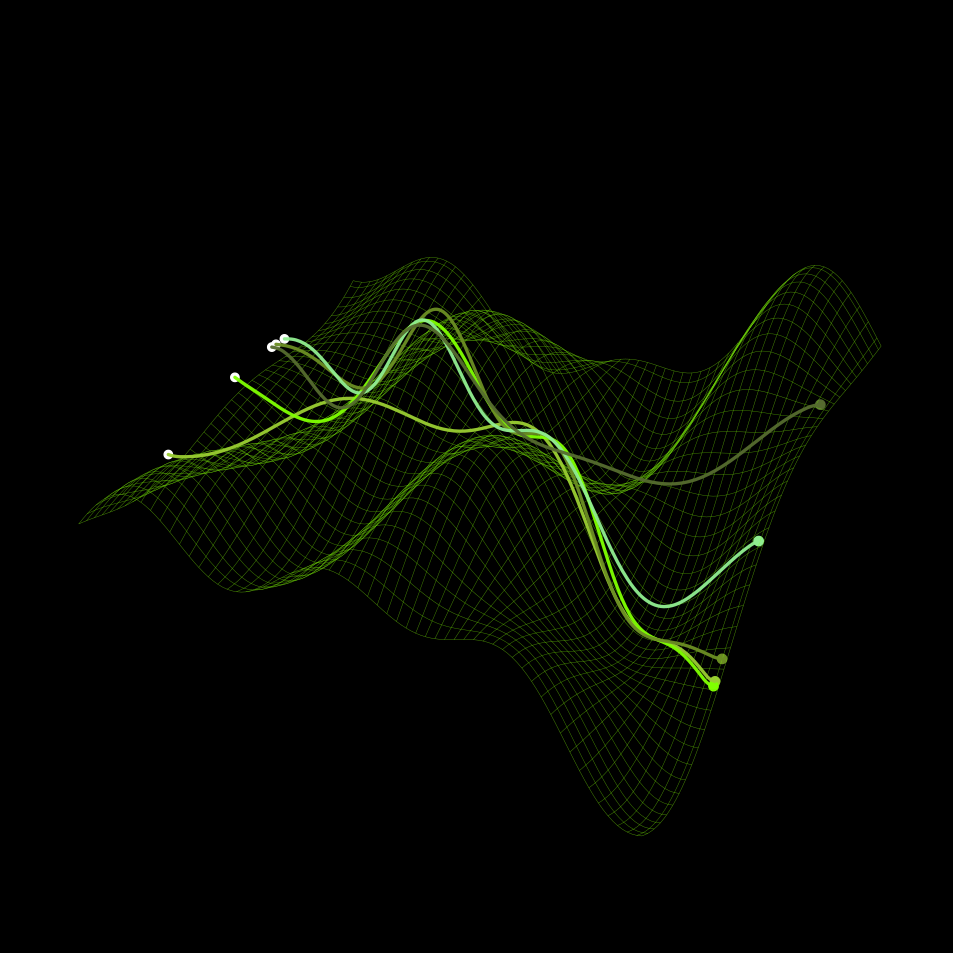
Heuristic diagram. Attentional trajectories navigating through a constraint-surface in attentional space. The wireframe mesh represents the probability landscape induced by compositional structure, with peaks and valleys shaping probable paths. Each trajectory follows a unique path through the same topological structure, demonstrating radical multiplicity: encounters with identical acoustic input yield divergent experiential paths.
Illuminations
Combinatorial explosion. A space with n dimensions and k distinguishable positions per dimension contains kn possible configurations. An m moment encounter constitutes a temporal sequence of m selections from this vast state space, admitting an upper bound of (kn)m possible trajectories. Path-conditionality constraints (where certain sequences unlock or foreclose regions) and non-repeatability (where attentional states cannot be identically revisited due to memorial or variable overlays) reduce this theoretical maximum, but the realizable trajectory space remains combinatorially vast.
Listening as navigation. This framework reconceptualizes musical listening from extraction to navigation. Instead of asking what features does this composition have?, the framework asks what paths does this composition enable?. Features become path-dependent: what an organism realizes depends on how it navigates the space. Encounters with the same composition exceed monolithic, object-deterministic ontology. A musical composition serves as invitation to exploration, a space to be traversed rather than an object to be decoded.
Irreproducibility. Each trajectory is irreproducible: attentional stochasticity as well as path-dependence yield divergent paths through attentional space, making identical trajectories vanishingly improbable. To produce identical trajectories across two encounters would require perfect replication of all conditions: identical organism state, identical environmental conditions, identical attentional starting points, and absence of memory traces from the first encounter. Under such ideal conditions, the encounters would collapse into phenomenal identity. Without memorial markers of secondness, there would be no phenomenological basis for distinguishing them as separate encounters. The subject would experience that very same encounter. What is experienced as repetition arises from overlay phenomena (againness, recognition, this-reminds-me-of), manifesting alongside qualitatively similar configurations. These memorial phenomena constitute the phenomenology of repetition itself: what makes a repeated motif feel like repetition rather than first occurrence is the presence of memorial qualities marking it as heard before. Phenomenal identity precludes repetition: to be attentionally the same is to be phenomenally one, not two. All felt repetition necessarily involves phenomenal variation through overlay effects that distinguish second encounters from first.
Stratification of radical multiplicity. Radical multiplicity operates at nested scales. A repeating motif, acoustically identical across iterations, may nonetheless manifest within evolving harmonic, rhythmic, and memorial contexts, ensuring each occurrence generates distinct attentional states. The motif becomes a locus of local similarity nested within scales of difference: surrounding harmonic progressions shift, accumulated listening history updates organism state, attention wanders to new regions. What recurs acoustically becomes phenomenologically novel through its changed embedding. Radical multiplicity does not mean every aspect must differ but only that the total configuration of each attentional state be unprecedented. Local repetitions (motivic returns, ostinatos, refrains) may coexist within global uniqueness. The framework accommodates musical repetition-structures while maintaining that even repeated material unfolds into multiplicity.
Revisitability. The proliferation of innumerable trajectories allows the same composition to be revisited repeatedly without exhaustion, echoing Adorno's insight that musical works resist complete realization (Adorno, 2006). This makes intelligible the phenomenology of longing that characterizes musical revisitation. An organism returns with dual motivations: seeking to recapture what it had before (though that configuration is irretrievably lost) while simultaneously seeking to encounter unrealized possibilities.
Interpretive diversity. Any organism encountering the same composition will trace different trajectories through attentional space. Each organism brings distinct perceptual capacities, cognitive schemas, memorial histories, and contextual embeddings, and necessarily occupies different starting positions and follows different accessibility gradients. Such multiplicity operates across different organisms as it does across temporal encounters of one organism. A composition does not encode a single correct experience to be extracted: what one organism hears as melancholic, another may experience as contemplative; what draws one organism's attention to harmonics leaves another focused on textures.
The receding horizon. Attending to one region of attentional space introduces accessibility gradients toward proximal regions, enabling reach into otherwise latent coordinates and creating ever-expanding territory. Attention cannot catch up to itself: the act of attending actively excavates the landscape into deeper regions, the horizon forever withdrawing as attention advances. This parallels what Marion describes as saturation: the attentional space exceeds attentional capacity through excess, too much to be grasped, intuition overflowing intention (Marion, 2002).
Towards a Generalization of Complex Signals
Abstracting from musical encounters exposes a core framework applicable to any complex signal. Radical multiplicity manifests wherever finite, variable attention situated within organism-environment couplings recursively samples high-dimensional state space shaped by signal-defined constraint-surfaces. This generalizes to any system where (1) processing unfolds in high-dimensional state space, (2) signals establish probability gradients without determining outcomes, (3) attention is finite and variable, and (4) recursion creates path-dependence. Radical multiplicity characterizes attentional encounters with any sufficiently complex signal yielding aesthetic experience: musical compositions, visual artworks, literary narratives, films, interactive environments across biological and artificial substrates.
Null Trajectory
A hypothetical system unconstrained by finite capacity would nullify radical multiplicity. A counterintuitive relationship is revealed: unconstrained attention yields singularity, while finite, variable attention manifests radical multiplicity. Unconstrained capacity or invariant attention forecloses the very proliferation of trajectories that characterizes the inexhaustibility of musical experience. Four limiting cases of the null trajectory reveal why these ideal conditions would not yield enriched experience, but rather attentional poverty.
Null-1: Uniform Saturation. Suppose attention could somehow occupy all regions of attentional space with equal intensity simultaneously. This configuration is structurally impossible. Certain regions exhibit mutual exclusivity: tension-states and release-states occupy incompatible coordinates; attending to one forecloses simultaneous occupation of the other. Other regions are path-locked: resolution-states become accessible only after traversing specific tension-states. Uniform distribution would require simultaneously occupying mutually exclusive regions and accessing path-locked regions without their prerequisite trajectories. Musical experience requires selective navigation, where attention traverses some regions while leaving others unvisited, carving the differential structure through which musical phenomena manifest.
Null-2: Compositional irrelevance. An unconstrained attention would be unperturbed by the constraint-surface's probability gradients: attractors would fail to pull it, repellors would fail to deter it. The composition's constraint-surface functions by creating differential accessibility, making certain trajectories more probable, certain regions easier to reach. Unconstrained attention encounters no differential resistance: all possible paths become equally likely for traversal, regardless of compositional structure. The constraint-surface's structuring gradients cease to shape navigation when attention has unconstrained capacity to overcome them. Compositional structure becomes non-functional. Its constraint-surface requires finite, variable attention for its guiding role to manifest.
Null-3: Temporal dissolution. Musical experience structurally requires finitude of temporal access and ordering: what comes before conditions what follows, creating development, anticipation, the sense of forwardness, ongoingness, and resolution. If attention could somehow sample all temporal positions simultaneously, temporality as a construct would collapse: path-dependence would not exist, and the lived experience of musical duration would dissolve. The feeling of subjective continuity, the sense of this follows from that, is itself an attentional state that emerges only through path-dependent temporal succession. This phenomenological quality cannot exist without the temporal architecture that generates it. Without the carving of temporal succession, there can be no unfolding, no arc, no trajectory.
Null-4: Invariant Attention. Even with finite capacity forcing selectivity, suppose attention were deterministic, always resolving to identical coordinates given identical compositional input. Deterministic attention would trace the same trajectory across all encounters with the same composition. Without variability, the same compositional substrate would always produce the same selective path through attentional space, impoverishing the organism's musical experience of its potential for variation and novelty. Radical multiplicity requires not only finite capacity forcing choices, but variability ensuring those choices differ.
Limitation is Generative
The null trajectory reveals that unconstrained or invariant attention would nullify radical multiplicity. Endless capacity would result in high-entropy disorder, total availability manifesting as undifferentiated white noise. Meaningful signal requires constraint. Limitation functions as a generative principle rather than deficiency (Heidegger, 1962). Finite, variable attention does not deprive aesthetic experience; it enables it. Without constraints forcing selective paths through attentional space, there would be no proliferation of trajectories, no call for revisitation, no further discoveries to be made, and no phenomenology of discovery itself. There would be exhaustion. The radical multiplicity of aesthetic experience arises from what finite attention cannot do: it cannot attend uniformly, cannot overcome compositional gradients, cannot collapse temporal succession, and cannot repeat deterministically.
The constraint-surface's guiding function depends on attention being subject to its attractors. Finite capacity makes attention susceptible to compositional pull: gradients shape trajectories precisely because attention lacks the capacity to overcome all resistance simultaneously. This susceptibility is the condition through which compositional structure manifests its guiding role.
Finitude is revealed as an existential prerequisite for aesthetic experience, with radical multiplicity as an intrinsic property. The conditions that enable aesthetic experience necessarily enable radical multiplicity. Finite, variable attention → phenomenological observation of multiplicity → structural requirement for degrees of freedom → high-dimensional attentional space → combinatorial vastness → inexhaustibility. One composition: innumerable realities. Where there is music, there is radical multiplicity.
references
[2] Gadamer, H.-G. (1975). Truth and Method. Seabury Press.
[3] Heidegger, M. (1962). Being and Time. Harper & Row.
[4] Itti, L., & Koch, C. (2001). Computational modelling of visual attention. Nature Reviews Neuroscience, 2(3).
[5] James, W. (1890). The Principles of Psychology. Henry Holt.
[6] Kahneman, D. (1973). Attention and Effort. Prentice-Hall.
[7] Lorenz, E. N. (1963). Deterministic nonperiodic flow. Journal of the Atmospheric Sciences, 20(2).
[8] Marion, J.-L. (2002). Being Given: Toward a Phenomenology of Givenness. Stanford University Press.
[9] Pöppel, E. (1997). A hierarchical model of temporal perception. Trends in Cognitive Sciences, 1(2).
[10] VanRullen, R., & Koch, C. (2003). Is perception discrete or continuous? Trends in Cognitive Sciences, 7(5).
[11] Wang, D., & Brown, G. J. (2006). Computational Auditory Scene Analysis. Wiley-IEEE Press.
cite
Dark. (2025). Radical Multiplicity. darXiv. https://doi.org/10.5281/zenodo.17577563